
Building the tools that make finding and managing a home simpler and more joyful
Finding and managing a home made easier
Sign up or keep scrolling to learn more. Live easier.
By submitting, you agree to our Terms of Use & Privacy Policy.
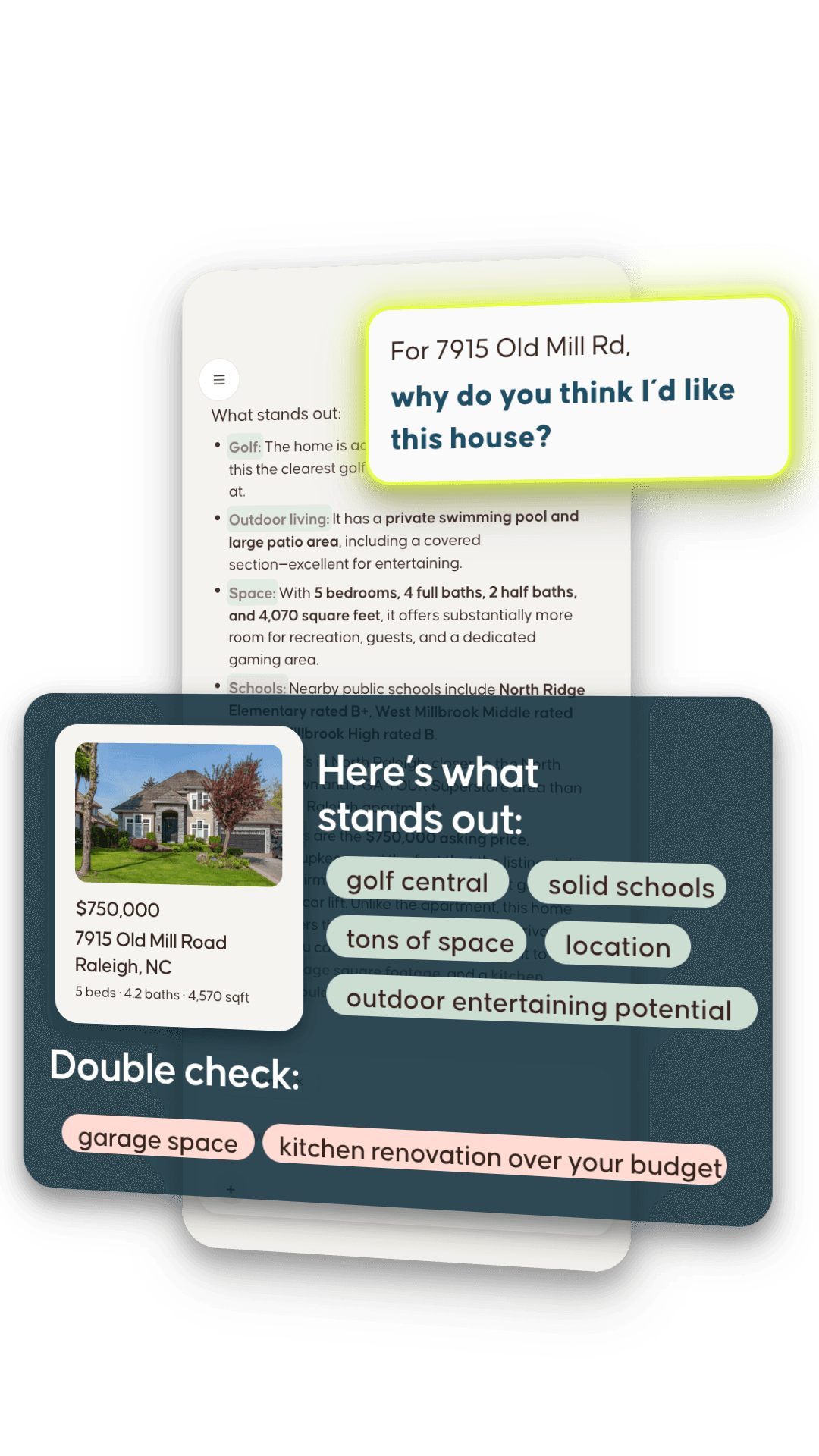
See what easy looks like.
Product tour
1 · Explore Neighborhoods
The right home is in the right place.
Ask about neighborhoods in plain language and compare them on price, feel, what’s nearby, and more. Just ask.
Tech's original promise
Life is hard. Technology is supposed to make it easier.
We think tech needs to live up to that promise for homebuyers and owners.
What credit score do I need for a conventional loan?
You typically need a credit score of 620 or higher for a conventional loan, though 680+ gets you better rates.
What's the minimum down payment on an FHA loan?
The minimum down payment for an FHA loan is 3.5% of the home's purchase price.
Do I really need 20% down to buy?
No, 20% down isn't required — you can put down as little as 3–3.5% depending on the loan type.
What's a good debt-to-income ratio for approval?
A debt-to-income ratio of 43% or lower is ideal for loan approval; most lenders prefer 36% or less.
What does PMI cost me monthly?
PMI (private mortgage insurance) typically costs 0.5–1.5% of your loan amount annually, paid monthly — so on a $300k loan, expect $125–375/month.
How long does closing take after an accepted offer?
Closing typically takes 30–45 days after an offer is accepted.
How many days do I have to waive an inspection contingency?
You typically have 7–10 days to waive an inspection contingency after an offer is accepted, though this varies by contract and location.
What's earnest money, and how much is normal?
Earnest money is a deposit showing you're serious about buying, typically 1–3% of the purchase price and held in escrow until closing.
How long is a mortgage pre-approval valid?
A mortgage pre-approval is typically valid for 60–90 days, though some lenders extend it to 120 days.
What's the difference between pre-qualified and pre-approved?
Pre-qualified is an informal estimate with no verification; pre-approved is a lender's formal commitment after checking your finances.
How much do property taxes add to my monthly payment?
Property taxes vary widely by location and home value, but typically add 0.8–2% of the home's price annually to your monthly payment.
What's a typical HOA fee?
HOA (homeowners association) fees typically range from $100–$500 monthly, depending on amenities and location.
Fixed 30-year vs. 15-year: how different is the payment?
A 15-year mortgage has higher monthly payments but you pay off the loan faster and pay less interest; a 30-year spreads payments lower over twice as long.
What's not covered by a seller's disclosure?
Seller disclosures vary by state, but typically don't cover issues the seller isn't aware of, cosmetic wear, or conditions visible during inspection.
What documents do I actually need before making an offer?
Pre-approval letter, proof of funds for down payment, and ID—that's the core; your agent handles the rest.
How do I read a property inspection report?
Focus on major systems (roof, HVAC, foundation, plumbing, electrical), flag any "repair needed" or "safety concern" items, and ignore minor wear.
What's a title search and why does it matter?
A title search verifies the seller owns the property and uncovers liens, claims, or disputes that could block your purchase or ownership.
What can a home appraisal reveal that an inspection can't?
An appraisal estimates the home's market value for the lender; an inspection checks condition and safety—they serve different purposes.
What renovations actually add resale value vs. money pits?
Kitchen, bath, and curb appeal return 50-80% of costs; pools, luxury upgrades, and niche styles often don't.
What's the difference between cosmetic updates and structural work?
Cosmetic updates (paint, fixtures, finishes) are surface-level and don't require permits; structural work (walls, foundation, framing) affects the home's integrity and does.
What red flags in a home inspection should actually kill the deal?
Foundation cracks, roof failure, mold, or major system issues (HVAC, plumbing, electrical) are deal-killers; minor repairs are negotiable.
Who pays for repairs found during inspection?
It's negotiable—you can ask the seller to fix it, credit you at closing, or walk away; "as-is" sales shift all risk to you.
Can I negotiate closing costs or is that set in stone?
You can negotiate closing costs with the seller or shop lenders for better rates, but some fees are fixed by law.
Should I pay points to lower my interest rate?
Points make sense if you're staying 5+ years; otherwise the upfront cost won't pay off before you sell or refinance.
What's the actual difference between 'under contract' and 'closed'?
Under contract means you've made an offer and it's accepted; closed means the deal is done, funds transferred, and you own it.
How many homes should I see before making an offer?
See 3-5 homes to understand the market and what fits your needs; more than that and you're overthinking it.
What does 'as-is' mean in a listing?
"As-is" means the seller won't fix anything—you buy it in its current condition, flaws and all.
Why do some states require attorneys to close a home sale and others don't?
Some states (mostly East Coast) require attorneys for title work and legal protection; others use title companies instead.
Do I need a permit for a bathroom remodel?
Yes—if you're moving plumbing, electrical, or ventilation, you need a permit; cosmetic-only updates might not.
What renovations require inspections?
Electrical, plumbing, HVAC, structural, and foundation work require inspections; cosmetic updates typically don't.
Why do old houses have crooked floors — is that always dangerous?
Crooked floors from settling are usually cosmetic; dangerous ones show foundation cracks, water damage, or structural failure—an inspector will flag the difference.
What's a 'due-on-sale clause' and why can't you just hand your mortgage to a buyer?
A due-on-sale clause requires the mortgage to be paid off when the home sells—the buyer gets their own loan, not yours.
What's 'knob and tube' wiring and why do insurers refuse to cover it?
Knob and tube is outdated, ungrounded wiring from the early 1900s that overheats and causes fires—insurers won't cover homes with it.
Why does radon testing matter even if a house has no visible cracks?
Radon seeps through soil and enters homes invisibly—cracks aren't required—and it's a leading cause of lung cancer; testing is cheap and critical.
What's the lifespan of a roof, HVAC, and water heater — and why do sellers rarely replace them before listing?
Roofs last 20-25 years, HVAC 15-20, water heaters 10-15; sellers skip replacement because buyers often negotiate repairs instead of paying upfront.
Why do some 100-year-old houses have better bones than new construction?
Old homes used solid wood and hand-built craftsmanship; new construction often cuts corners with cheaper materials and faster timelines to maximize profit.
Why is home insurance becoming impossible to get in Florida and California?
Hurricanes, wildfires, and rising claims have made insurers pull out or raise rates; state-run insurers are overwhelmed and underfunded.
What's 'shadow inventory' and how does it quietly affect prices?
Shadow inventory is homes off-market (foreclosures, probate, rentals owners might sell)—when it floods the market, prices drop fast.
What's a 'ghost HOA' and why do some subdivisions have no active board?
A ghost HOA is dormant but still legally exists—no active board means no maintenance, but you're still liable for future assessments if it reactivates.
Can an HOA really fine you for the color of your front door?
Yes—if your HOA bylaws restrict exterior colors, they can fine you; read the CC&Rs before buying in an HOA community.
Why do some neighborhoods have unusually high flood insurance even without a nearby river?
Poor drainage, low elevation, or historical flooding data can put a home in a high-risk zone even without a visible water source nearby.
What's 'gentrification lag' — why do prices rise years before the neighborhood visibly changes?
Investors buy early on rumors of development or transit; prices spike before schools improve or shops open—early buyers profit, late ones overpay.
Should I renovate before selling or let the buyer choose?
Strategic renovations (kitchen, bath, curb appeal) boost sale price and speed; cosmetic choices are better left to buyers.
Do I need permits for renovations, or can I DIY under the radar?
Most structural, electrical, and plumbing work requires permits; skipping them risks fines, failed inspections, and liability when you sell.
Why is my neighbor's identical house worth $50K more?
Lot size, view, condition, updates, or even how the listing is marketed can shift value; comps aren't always truly comparable.
Can I sue my contractor if the work is terrible?
Yes, if it violates the contract or code; document everything and get a second opinion before paying final invoice.
Will adding a pool increase my home's value?
Pools rarely return their cost; they're a lifestyle choice, not an investment—and they scare off buyers in cold climates.
What happens if I find mold after closing?
You own it now; your recourse depends on whether the seller disclosed it or hid it—consult a real estate attorney.
Is it worth buying a "fixer-upper" to flip?
Only if purchase price + renovation costs are 20–30% below comparable finished homes; most flips fail on math.
Can my HOA really force me to paint my house?
Yes, if it violates CC&Rs (covenants, conditions, and restrictions) they can fine you or place a lien if you don't comply.
Should I buy a home with a septic system?
Septic systems cost $3K–$5K to pump every 3–5 years and can fail catastrophically; factor that into your offer.
Why do appraisals sometimes come in low?
Appraisers use comps, not your offer price; if the market is soft or comps are weak, the appraisal won't match your bid.
Can I get my earnest money back if the deal falls through?
Only if you invoke a contingency (inspection, appraisal, financing); if you back out without cause, you lose it.
Is it smarter to buy a new build or resale?
New builds have warranties but hidden costs; resales have history but surprises—both can be good deals depending on the market.
Owning a home is one of the most exciting things you'll ever do
Owning a home is one of the biggest things you'll ever do
Owning a home is one of the most life changing things you'll ever do
It can also be one of the most stressful.
So we built House IQ to give
transparent,
fact‑based,
unbiased
answers to your questions.
Some numbers
For life's biggest questions, your technology should be there for you.
Homebuyers
76%
of homeowners lack homeownership literacy at the time of purchase.
Homeowners
92%
of homeowners have a repair they've been putting off.
Homebuyers and owners, you deserve to feel supported.
We're just getting started.
We're excited to be building for a better industry.
Come join us from the beginning and let us know how we can make your life easier through technology.
By submitting, you agree to our Terms of Use & Privacy Policy.